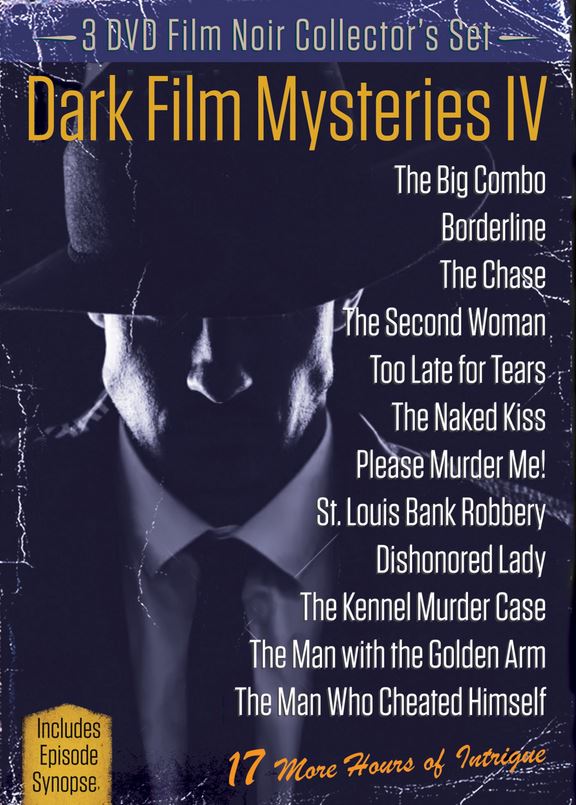
Dark Film Mysteries IV
Film Chest DVD $19.99
Available from various e-tailers
We were unaware that there were volumes I, II, and III and yet here we are with an IV unit featuring a dozen dark dramas (mostly) in a budget package. Here’s a thumbnail of each.
The Big Combo (Allied Artists 1955, Dir. Joseph H. Lewis, 88 min.) Cornel Wilde is a detective on the trail of the city’s kingpin of crime, Richard Conte. Cool blonde Jean Wallace is the dame both men want.
Actual noir content: Are you kidding? Off the charts, and John Alton’s cinematography has never been better.
Dramatic Highlight: A busy municipal airport portrayed by a fog machine, a corrugated steel wall, and a revolving light on a pole.
Cinematic Historical Fact: Earl Holliman and Lee Van Cleef are the most openly gay hitmen in the Code era and how they got past the censors nobody knows.
Classic dialog: “A woman doesn’t care how a man makes a living. Only how he makes love.”
Borderline (Universal 1950, Dir. William A. Seiter, 88 min.) Raymond Burr is smuggling dope from Mexico to California (oh, so HE’S the one) and two crack undercover agents, Claire Trevor and Fred MacMurray, team up to put a stop to it, although neither knows the other is a good guy (or gal).
Actual noir content: You could put Raymond Burr in a Lassie picture and make it a noir, but there’s a lot of romance and would-be comedy in the picture that you have to step over the corpses to get to.
Dramatic Highlight: The parrot. You have to see the parrot.
Cinematic Historical Fact: Miss Trevor’s husband produced the film, and it’s rumored she never got paid for it.
Classic dialog: “I can keep my mouth shut in two languages.”
The Chase (United Artists 1946, Dir. Arthur Ripley, 86 min.)
Ex-Navy officer Robert Cummings is having trouble coping with post-war reality and is down on his (and everyone else's) luck. He finds a wallet and returns it to its owner, brutal gangster Steve Cochran, who admires his honesty and promptly hires him as chauffeur and as a companion for the gangster's lovely wife. Uh-oh.
Actual noir content: No complaints from me, and it’s based on a book by Cornell Woolrich.
Dramatic Highlight: The gangster has his own acceleration pedal in the back of the car.
Cinematic Historical Fact: The cattleman with the big, big hat is Don Wilson, long time announcer and Lucky Strikes salesman on the Jack Benny program.
Classic dialog: Psychiatric advice from Dr. Jack Holt: "A drink will do you a lot of good, help you let go of the tension. That's all you need, Chuck, ease the tension."
The Second Woman (United Artists 1950, Dir. James V. Kern, 91 min.) Robert Young is recovering from the untimely death of his fiancé, but he seems to have a cursed life, as tragedy and death follow him like flies behind a garbage truck. Can lovely Betsy Drake help him? Not really, no. It’s complicated.
Actual noir content: I’d call it more of a mystery than a noir; you know how picky I am.
Dramatic Highlight: The film’s poster compared it to Alfred Hitchcock’s Spellbound. Mr. Hitchcock was undoubtedly not amused.
Cinematic Historical Fact: Jean Rogers, Dale Arden in the Flash Gordon serials, plays a character named Dodo, and future adult Mouseketeer Jimmie Dodd is in this too but I forget his name. Sorry, there’s a lot of movies in this set.
Classic dialog: “Lightning can strike in the same place twice. But not six times!”
Too Late for Tears (United Artists 1949, Dir. Byron Haskin, 100 min.)
Lizabeth Scott and Arthur Kennedy are your typically not-exactly-happy-but-relatively-satisfied married couple until somebody tosses a valise with $60,000 in it into their open automobile on one dark night. He wants to hand over the dough to the cops, she wants to keep it and spend every last nickel, and while they argue this out Dan Duryea shows up looking for his cash and Liz decides she’d rather have him and half the loot than her husband and nothing.
Actual noir content: If it were any noirier, the streets of my hometown would be foggy and rain-swept and stuck in perpetual night every day of the year.
Dramatic Highlight: You can tell Arthur Kennedy is a dead man a minute and a half after you meet him.
Cinematic Historical Fact: The film did poorly at the box office and was acquired for re-release by Astor Pictures, the folks behind Cat-Women of the Moon, who retitled it Killer Bait.
Classic dialog: Miss Scott: “What do you I call you, besides stupid?” Mr. Duryea: “Stupid will do, if you don’t bruise easily.”
The Naked Kiss (Allied Artists 1964, Dir. Sam Fuller, 90 min.)
A former prostitute cannot escape her past. That’s pretty much the whole plot because if we revealed any more details, this website would be shut down and I’d be arrested.
Actual noir content: 1964 is a little late for noir and a little early for neo-noir, so let’s call it a seamy melodrama.
Dramatic Highlight: A woman returns $25 in cash by shoving it down a bordello madam’s throat. Ouch.
Cinematic Historical Fact: Amongst the supporting cast you’ll find Betty Bronson, who played Peter Pan in the 1924 film, and Patsy Kelly, who played Thelma Todd’s partner in 1930s two-reel comedies.
Classic dialog: “Once before, a man's kiss tasted like that. He was put away in a psycho ward.”
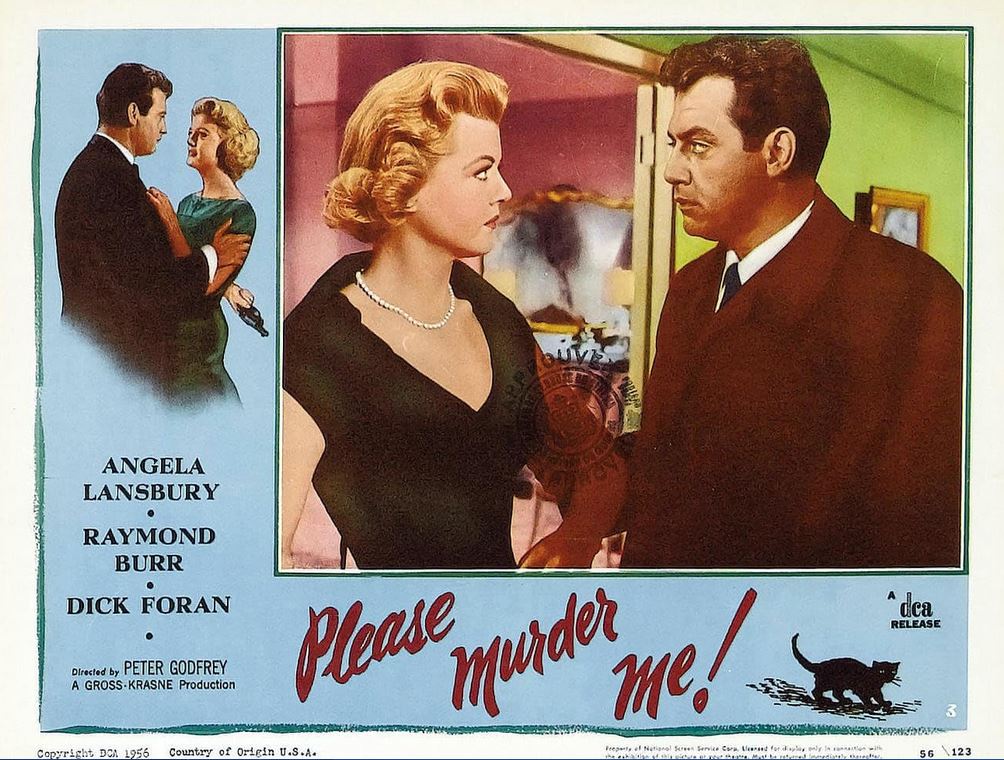
Please Murder Me! (DCA 1956, Dir. Peter Godfrey, 78 min.)
Raymond Burr and Dick Foran are old Army pals, but they both are in love with Angela Lansbury, who happens to be married to Mr. Foran. When she shoots him (Dick, not Raymond) dead, Mr. Burr - who happens to be a crack defense attorney, who knew? - defends her in court, but Angie has some tricks up her sleeve. Very low-budget turkey. How do you make a movie this dull with Raymond Burr and Angela Lansbury?
Actual noir content: If you can stay awake, you’ll find more of a courtroom drama with Mr. Burr as a crafty defense attorney but you’ll wonder where William Talman and Ray Collins and Barbara Hale and William Hopper are.
Dramatic Highlight: The look on Miss Lansbury’s face when she realizes the jig is up will make you think she’s about to start singing to distract everybody.
Cinematic Historical Fact: In 1963, legendary Cleveland horror host Ghoulardi actually showed this film, in between showings of Attack of the Crab Monsters and Indestructible Man.
Classic dialog: "How come everybody always shoots everybody else in self-defense?"
The Great St. Louis Bank Robbery (United Artists 1959, Dir. Charles Guggenheim, 89 min.)
The guy who played Walter Cunningham in To Kill a Mockingbird is plotting the robbery of a St. Louis bank, and his misfit mob includes a young ex-college football star portrayed by Steve McQueen, giving all of us a reason to watch the movie. If only it had a blob in it.
Actual noir content: Are heist movies film noir? Then it’s film noir.
Dramatic Highlight: Mr. McQueen explaining to his girlfriend that he needs the money from the bank robbery so he can go back and finish school (we used to sell magazine subscriptions back in MY day).
Cinematic Historical Fact: The film is based on an actual 1953 bank robbery that pretty much ended up the way the film did, not going so well for the heisters, but then, it rarely does, crime not paying and all.
Classic dialog: Steve, on being a college football hero: “They make you feel like you're God or something. One mistake, and you find out you're just hired help.”
Dishonored Lady (United Artists 1947, Dir. Robert Stevenson, 85 min.)
Hedy Lamarr is the successful but unhappy editor of a New York City fashion magazine; after an unsuccessful suicide attempt, she decides to chuck that all aside and go back to painting, but her troubled past love life returns with a vengeance.
Actual noir content: It’s a woman’s picture that women are going to hate, and I’m frankly not sure men would like it all that much, either.
Dramatic Highlight: Well, I can safely say I’ve never seen anyone beaten to death with a cigarette lighter before.
Cinematic Historical Fact: John Loder plays one of Miss Lamarr’s boyfriends; they were married in real life and their relationship did not survive making this picture together.
Classic dialog, from another one of her boyfriends: “You know it’s awfully hard making love to a woman who makes more money than me.”
The Kennel Murder Case (Warner Bros. 1933, Dir. Michael Curtiz, 73 min.)
Philo Vance is investigating the murder of a wealthy dog breeder and his brother in that Philo-Vancian way. After a handful of films starring William Powell as Vance at Paramount, the property and Mr. Powell moved over to Warner Bros. for this one. Mary Astor co-stars.
Actual noir content: This is about as much a noir as The Wizard of Oz is.
Dramatic Highlight: It’s such a cliché for a corpse to fall out of a coat closet in murder mysteries that I’m always surprised the detective doesn’t just go look there first.
Cinematic Historical Fact: This was the fourth and final appearance as Philo Vance for William Powell, who went over to MGM to play Nick Charles in the Thin Man pictures instead.
Classic dialog: “Don't bother me with any murders after 3:00 tomorrow. I'm going to the World Series.”
The Man with the Golden Arm (United Artists 1955, Dir. Otto Preminger, 119 min.)
Frank Sinatra is an ex-con and recovered drug addict trying desperately to remain recovered, but he moves back to his old neighborhood in Chicago, and since the Bears are even leaving there, it’s a terrible idea. Darren McGavin is the drug dealer, and Eleanor Parker and Kim Novak are the ladies in Frankie’s life.
Actual noir content: Arguably the only film noir ever produced with Arnold Stang in a major role.
Dramatic Highlight: The sudden realization that you’re actually watching a ‘A’ picture.
Cinematic Historical Fact: Nominated for three Academy Awards!
Classic dialog: “I'm not smart enough to be running around loose and too goofy to be locked up”
The Man who Cheated Himself (20th Century Fox 1950, Dir. Felix E. Feist, 81 min.)
Lee J. Cobb and John Dall are not only brothers but detectives working on a murder case, and Det. Dall doesn’t suspect that the killer is Det. Cobb’s girlfriend and big brother is covering up for her.
Actual noir content: Just convoluted enough to be considered prime noir, sure.
Dramatic Highlight: Cobb is completely loyal to his kid brother right up until he has to conk him over the head.
Cinematic Historical Fact: Oh, so Vertigo isn’t the first film to use Fort Point under the Golden Gate Bridge as a key filming location. Who knew?
Classic dialog: Lee’s advice to his kid brother on how to be a successful detective: “Never take a case to bed.”
This Public Domain collection is an inexpensive set of unrestored movies that is here for quantity, not quality, and the films are watchable without being impressive; some are better than others, naturally. It’s a three-disc set with four films per disc, and there’s a four-page full-color brochure included with notes on each film.
It’s a good way to get a nice, basic film noir collection and it brings back the late-night TV watching of my youth, because I occasionally interrupted the films for vintage commercials for garage door openers and dog food.
"My lipstick."
"Colt, or Smith & Wesson?”